|
Archaeology, Ethnology & Anthropology
of Eurasia
54 (3) 2026
doi:10.17746/1563-0110.2026.54.3.043-052
|
Annotation:
A Glass Intaglio Depicting Harpocrates (Zeus Kasios)
from Markula, Abkhazia
E.K. Stolyarova1, V.G. Chernenko2, V.G. Yurkov1, 3, S.M. Sakania4, and G.V. Trebeleva3
1Lomonosov Moscow State University, Lomonosovsky pr. 27, bldg. 4, Moscow, 119234, Russia
2State Historical Museum, Krasnaya pl. 1, Moscow, 103012, Russia
3Institute of Archaeology, Russian Academy of Sciences, Dm. Ulyanova 19, Moscow, 117292, Russia
4Gulia Abkhazian Institute for Humanitarian Studies, Academy of Sciences of Abkhazia, Aidgylara 44, Sukhum, 384900, Republic of Abkhazia
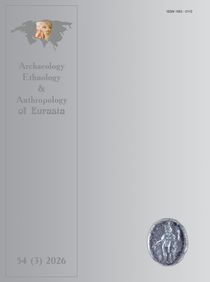
We describe a glass intaglio with an impressed image, excavated by the International Russian-Abkhazian Archaeological Expedition from the Russian Academy of Sciences Institute of Archaeology and the Academy of Sciences of Abkhazia Institute for the Humanities at the Markula settlement in 2022. The archaeological context and iconography of the image are described. The standing figure in the center is interpreted as that of Harpocrates (Zeus Kasios) wearing the hemhem crown, holding a pomegranate in his right hand. In his left hand, there is a branch, for which a child or pygmy reaches. Regarding the origin of this cult, some experts believe that during the Ptolemaic era, Zeus Kasios was a Near Eastern reflex of the Greek Zeus, identified with Baal-Zaphon. The iconographic type described in this study, also known as Harpocrates of Pelusia, was related to new Egyptian interpretations. The god's name—Harpocrates, or Zeus Kasios—reflects the blend of his functions as a solar deity and patron of seafarers with his prophetic gift, highlighting his youthful appearance known from graphic and written sources. The closest parallels are found among engraved gems and coins of the 3rd century AD. As compared to them, the image on the Markula intaglio is mirrored, making it impossible to establish the production technique with certainty. Possibly, an impression was made on softened glass with a ceramic or metal mold, copying the image on a currently unknown gem. After cooling, the image's details were finished using cold engraving. The analysis of the glass's composition suggests that the intaglio was made at an Egyptian workshop. The intaglio likely arrived in the region via trade contacts or with a Roman legionary. It is concluded that the discovery of this ornament not merely reflects the syncretic nature of Roman religion, but also suggests that the local population was familiar with the diversity of the provincial cults of the Roman Empire.
Keywords: Markula settlement, glass intaglio, Roman glassmaking, Harpocrates, Zeus Kasios.