|
Archaeology, Ethnology & Anthropology
of Eurasia
53 (2) 2025
doi:10.17746/1563-0110.2025.53.2.045-053
|
Annotation:
An Unusual Bronze Figurine from the Samartai Museum, Yakutia: The “Thing-in-Itself” and Semantic Content
R.I. Bravina1 and V.M. Dyakonov1, 2
1Institute for Humanities Research and Indigenous Studies of the North, Siberian Branch, Russian Academy of Sciences, Petrovskogo 1, Yakutsk, 677027, Russia
2Institute of Archaeology and Ethnography, Siberian Branch, Russian Academy of Sciences, Pr. Akademika Lavrentieva 17, Novosibirsk, 630090, Russia
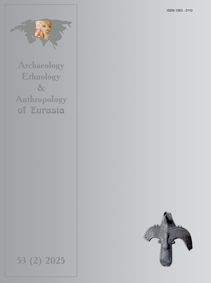
This article presents a rare bronze idol—a winged bear with an anthropomorphic mask and a bear head on the chest. The artifact was found in the Khangalas Ulus (district) of Yakutia and is kept in the Samartai Museum in the village of Kerdem. The search for parallels led to a wide range of Early Iron Age and medieval cultures of the Western Urals and Western Siberia. Similar composite images are common among cast ritual items relating to the Pechora, Perm, and Western Siberian animal styles. Chemical analysis showed that the sculpture was made of tin bronze with the addition of iron. This bronze idol could have been brought to Yakutia by tradesmen or Cossacks. While being quite unusual for Yakutia, it could have been used to represent a patron spirit or aid in shamanic or domestic rituals, being consonant with Yakut religious, specifically totemic beliefs, as evidenced by numerous ethnographic sources.
Keywords: Samartai Museum, cast ritual items, winged bear, bird with mask on the chest, Western Siberian animal style, shamans